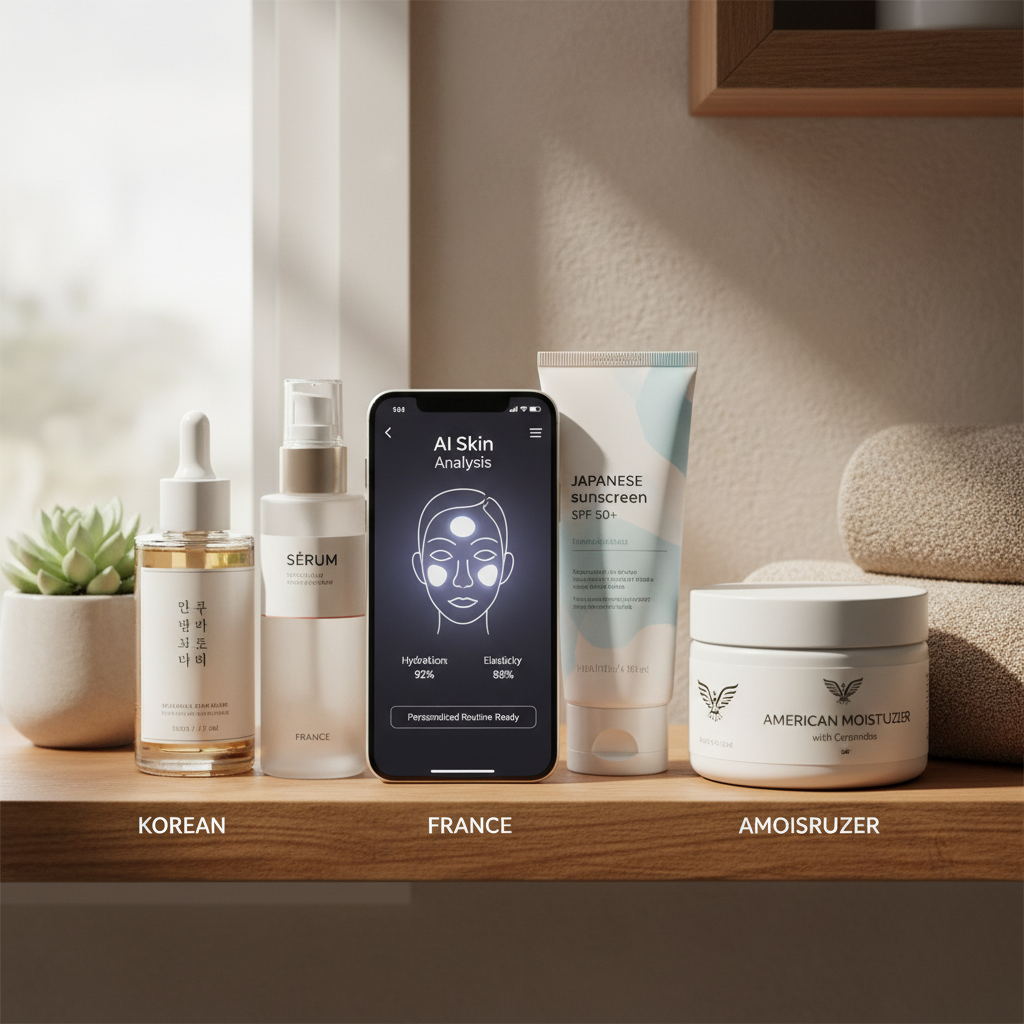
We explore how the global beauty industry is changing in 2025: from science-backed skincare and AI-driven personalization, to clean and inclusive beauty, social shopping, and cross-border buying habits that shape what ends up on our bathroom shelves.
Definition
What is global beauty industry trends? It describes how skincare, makeup, haircare and wellness products evolve worldwide each year, shaped by consumer needs, technology, sustainability, culture, and cross-border e-commerce behaviour.
Key points at a glance
- The global beauty market is expected to pass 600 billion US dollars by 2025, driven by skincare and emerging markets.
- Consumers worldwide are shifting from appearance-only beauty to health, science and skin barrier focused routines.
- AI, AR and data-driven personalization are moving from marketing gimmick to daily shopping tools.
- Clean, ethical and environmentally responsible formulas and packaging are becoming basic expectations, not niche options.
- Inclusive shade ranges, gender-fluid products and cultural diversity are reshaping product development and branding.
- Cross-border e-commerce lets us mix Korean, Japanese, European and American favorites into one routine.
Where the global beauty industry stands in 2025
When we open our bathroom cabinets in 2025, we are also seeing a snapshot of a huge global market. Industry analysts estimate that the global beauty and personal care market is on track to exceed around 600 to 625 billion US dollars in value by 2025, with an annual growth rate in the mid single digits. Skincare and haircare are growing faster than classic colour cosmetics, and online channels are gaining share in almost every region. Asia-Pacific, especially China, South Korea and Southeast Asia, continues to be one of the most dynamic regions, while North America and Western Europe remain high value, trend setting markets.
Researchers and market reports consistently highlight a few common drivers. We care more about long term skin health, and we are reading ingredient lists more carefully. We are also shopping across borders more frequently, particularly for Korean and Japanese skincare, niche European brands, and dermatologist inspired American lines. According to a global beauty report from McKinsey, direct to consumer brands and digital native players are outperforming overall market growth, helped by social media and cross-border logistics.
If we want to explore the data more deeply, we can look at sources such as the McKinsey “The beauty market in 2023” article, which discusses growth by category and region, or the Statista projections on global beauty and personal care revenue by segment. These help us understand where demand is truly increasing and how our own shopping habits fit into the bigger picture.
For further reading on market size and growth, we can refer to external sources such as: McKinsey analysis on the beauty market, market data overview from Statista, a global beauty report by Vogue Business, a Euromonitor based summary from Forbes, and ingredient science coverage from the British Journal of Dermatology via academic search tools.
Five global beauty industry trends consumers feel in daily life
1. Science backed, skin barrier focused routines
Across countries, we are becoming amateur skin scientists. Instead of buying whatever looks pretty on a shelf, many of us now ask simple but powerful questions: Will this damage or support my skin barrier, and is there clinical proof? Dermatology research has made barrier function, microbiome balance and gentle exfoliation mainstream ideas. Ingredients like ceramides, niacinamide and peptides show up in our night routines, not just in professional products. During 2024 and 2025, we also saw a clear reaction against over-exfoliation and heavy use of strong acids, as people experienced irritation and sensitivity. In response, brands launched corrective barrier creams, minimalist routines and multitasking serums that combine hydration, barrier repair and mild actives in one step.
Many of us share before and after photos in communities, comparing how our skin looks after three months of gentle, consistent care. We also see more transparent claims, often with links to clinical trials or ingredient studies. When we research ingredients, we can search academic databases for terms like niacinamide randomized trials or ceramide barrier repair, which bring up dermatology papers rather than only marketing claims.
2. AI personalization and virtual try on as everyday tools
Virtual try on used to be a fun novelty. In 2025, for many of us it is how we actually choose a foundation shade, a lipstick or even hair colour before buying from a cross-border e-commerce site. We upload a selfie, the system maps our face, and we can cycle through shade options that adjust in real time. AI skin analysis apps now scan our skin texture, redness and pigmentation and generate ingredient focused recommendations. Some platforms can even build a basic routine by reading product ingredient lists and matching them to our needs, such as brightening, hydration or oil control.
We notice this when we shop from different countries. A Korean platform may recommend lightweight gel textures for humid climates, while a European pharmacy site highlights rich creams for dry or cold weather. The personalization is far from perfect, but it helps narrow choices in a global market with thousands of similar sounding serums. Over time, as these systems learn from our actual reorders and reviews, they become a quiet assistant that remembers what our skin liked last winter better than we do.
3. Clean, ethical and low waste expectations
Clean beauty used to be a niche, sometimes confusing label. In 2025, it has evolved into a broader expectation around safety, transparency and responsibility. Many of us now mentally scan for a few things when we scroll: clear ingredient lists, cruelty free statements, limited use of certain preservatives or fragrances if our skin is sensitive, and some attempt to reduce packaging waste. Glass bottles, refill systems and lighter outer boxes are increasingly normal in both Western and Asian brands.
At the same time, regulatory agencies in major markets are tightening rules on labelling and claims. This pushes brands to rely less on vague marketing terms and more on measurable benefits, like percentage improvement in hydration or wrinkle depth in clinical tests. From a consumer perspective, this makes it easier to compare products across borders. A serum from France, a toner from Korea and a cleanser from the US can all be evaluated by reading ingredients and looking for specific performance data, rather than decoding unfamiliar national marketing terms.
4. Inclusive shades, genders and cultures
Inclusivity is no longer just a campaign theme. In 2025 we can see it directly in product assortments and in the images on product pages. Foundation ranges often extend far beyond the classic light to tan spectrum, with specific undertones for deeper skin. Sunscreens increasingly avoid white cast so that darker skin tones can use high protection without a grey or purple tint. Haircare shelves now recognise curls, coils and protective styles, not only straight or lightly wavy hair.
Gender is also handled more fluidly. Many body care, fragrance and even makeup lines use language like for everyone or skin first, makeup second, removing references to traditional gender norms. This matters in our daily life because it lets us choose based on our actual preferences rather than feeling a product was not made for us. Social proof plays a big role here: we follow creators from different backgrounds and see how products look on their skin and fit into their routines. Their reviews, and the photos from everyday buyers, often guide our decisions more than brand ads.
5. Cross-border beauty as a normal part of our routines
Ten years ago, buying a serum from Korea, a Japanese sunscreen and a French pharmacy cream in one order felt special. In 2025, this is just how many of us shop. Global logistics, improved customs processes and localised online storefronts have turned cross-border beauty into an everyday habit. We may watch a Korean influencer demonstrate a new essence at night, then order it the next morning from an international marketplace in our own language and currency.
User reviews and social proof are especially powerful across borders. When we cannot walk into a physical store, we depend on swatch photos, routine breakdowns and long term reviews from people with similar skin types and climates. A buyer in Brazil may help another buyer in Indonesia decide whether a European retinol is too strong for humid weather. As more platforms standardise return policies and offer local customer support, our confidence in trying global brands increases, and the industry shifts from local competition to a truly worldwide mix of options on our shelves.
Traditional beauty versus the 2025 landscape
| Feature | Traditional beauty market | Beauty market in 2025 |
|---|---|---|
| Product focus | Colour cosmetics and fragrance, appearance first | Skin health, barrier repair, multifunctional skincare and hybrid makeup |
| Decision drivers | Counter advice, advertising, local brand familiarity | User reviews, clinical data, ingredient education, creator recommendations |
| Technology role | In store testers and static shade charts | AI skin analysis, AR try on, personalised routines and data based suggestions |
| Ethics and sustainability | Limited discussion outside niche brands | Mainstream expectation for cruelty free, transparent sourcing and lower waste packaging |
| Diversity and inclusion | Narrow shade ranges and gendered marketing | Broader shade spectrums, gender neutral positioning, diverse imagery |
| Shopping geography | Mostly domestic brands and offline retail | Cross-border e-commerce, localised global platforms, multi origin routines |
Step guide: how we can shop global beauty more confidently
With thousands of products crossing borders, it is easy to feel overwhelmed. We can use a simple, practical process to choose wisely while still enjoying discovery.
- Step 1: Clarify one or two priorities for the next three months, such as hydration, calming sensitivity or sun protection, instead of trying to fix everything at once.
- Step 2: Check our current routine and remove products that cause stinging, redness or tightness, so that we have a calmer base before adding new global finds.
- Step 3: Read ingredient lists for potential irritants based on our own history, and search for key ingredients plus the word study or trial to see if there is supporting evidence.
- Step 4: Use AI skin analysis or online quizzes as a starting point, but cross check results with independent reviews from people with similar skin type and climate.
- Step 5: Start with travel sizes or mini sets when possible, especially for strong actives like retinoids or acids, before committing to large cross-border orders.
- Step 6: Keep a simple skin diary for a few weeks, noting any changes when introducing a new product, so we can decide calmly whether it truly helps before repurchasing.
- Step 7: Pay attention to customs rules, ingredient regulations and return policies in our country, so that our global beauty journey stays smooth and predictable.
How data and research shape these trends
Behind every serum on our shelf, there are layers of research and market data. For instance, McKinsey estimates that skincare will continue to outpace makeup in growth as consumers seek wellness linked benefits. Statista data shows that online channels are gaining share in both premium and mass segments, with especially strong growth in Asia and the Middle East. Industry news outlets like Vogue Business and Forbes have reported on the rise of science backed, derm inspired brands and the shift to refillable packaging and eco conscious formats.
On the scientific side, dermatology journals track how ingredients such as retinoids, vitamin C derivatives and new peptide technologies affect skin health. As consumers, we may not read every paper, but it is comforting to know that behind honest brands there are actual studies and regulatory standards. When we see claims like reduces wrinkles in four weeks, we can look for references to clinical testing, sample size and measurement methods. Over time, this creates a more mature beauty culture where marketing language and real world performance come closer together.